

The global average cost of a data breach reached $4.44 million in 2025, according to IBM's 2025 Cost of a Data Breach Report, down from $4.88 million the year prior. The average breach cost in the United States rose to $10.22 million, driven largely by regulatory fines and slower detection times. These figures explain why boards, investors, and enterprise customers now ask small and mid-sized companies a question that used to belong only to large corporations: what is the formal system for managing governance, risk, and compliance obligations.
Governance, Risk, and Compliance (GRC) is the discipline that answers that question. It refers to the coordinated set of policies, processes, and controls an organization uses to set direction, manage uncertainty, and meet legal and contractual obligations. By the official OCEG definition, GRC is an integrated capability to reliably achieve objectives, address uncertainty, and act with integrity. For small and medium-sized businesses (SMBs) in regulated industries, GRC has stopped being an enterprise luxury. Client contracts, cyber insurance underwriting, and frameworks such as System and Organization Controls 2 (SOC 2) and the Health Insurance Portability and Accountability Act (HIPAA) now expect a documented program, not a folder of ad hoc policies.
What Is GRC, Exactly? Governance, Risk, and Compliance Broken Down
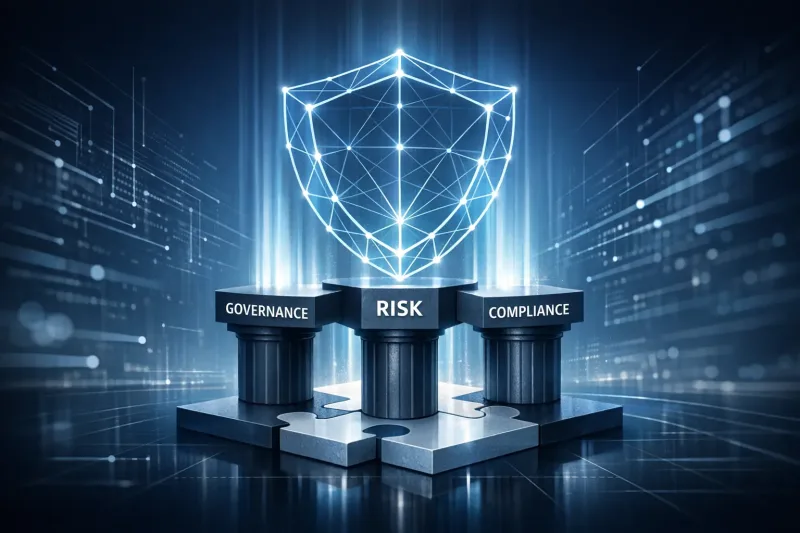
GRC breaks down into three distinct but connected disciplines. Governance covers the structures and decisions that direct an organization toward its objectives, including board oversight, policy ownership, and accountability for outcomes. Risk management covers the identification, assessment, and treatment of events that could interfere with those objectives, including cyberattacks, vendor failures, and operational disruption. Compliance covers adherence to the laws, regulations, and contractual commitments that apply to the business.
The term itself is relatively recent. GRC emerged from the need for better internal control and governance within large enterprises in the early 2000s, driven largely by compliance requirements tied to the Sarbanes-Oxley Act (SOX) of 2002. What began as a financial reporting concern for public companies has since expanded into cybersecurity, privacy, and operational resilience for organizations of every size.
The Cybersecurity Compliance Pressure Behind the GRC Conversation
Cybersecurity compliance has become the primary driver pushing GRC into the SMB conversation. Healthcare practices face HIPAA obligations, software companies face SOC 2 requests from enterprise buyers, and defense contractors face the Cybersecurity Maturity Model Certification (CMMC). Each of these frameworks asks for evidence of the same underlying discipline: documented governance, an active risk assessment process, and controls that get tested rather than filed away.
Market data reflects this shift. Large enterprises controlled 69.60% of GRC software revenue in 2025, but small and medium-sized enterprises are forecast to grow at a 13.02% compound annual growth rate through 2031. That growth curve signals demand catching up with need, not a market that has already solved the SMB problem.
A List of IT Frameworks Every SMB Should Recognize
GRC is not a single standard. It is a discipline supported by several frameworks, each covering a different slice of governance, risk, or compliance. The Information Technology (IT) and risk frameworks referenced most often in SMB compliance work include:
- Committee of Sponsoring Organizations of the Treadway Commission (COSO): a framework for internal control originally built for financial reporting integrity.
- National Institute of Standards and Technology (NIST) Cybersecurity Framework (CSF): a voluntary structure for managing cybersecurity risk.
- International Organization for Standardization (ISO) 27001: a certifiable standard for information security management systems.
- ISO 31000: enterprise-wide risk management guidance without a certification component.
- SOC 2: an attestation report commonly requested by SaaS customers and partners.
- HIPAA: the federal law governing protection of health information.
- CMMC: the Department of Defense's certification program for contractors handling controlled information.
The COSO Framework: Where Modern Governance Started
COSO developed its framework to give senior executives better ways to control their enterprises and to help ensure that organizational objectives related to operations, reporting, and compliance are achieved. It includes five components: Control Environment, Risk Assessment, Control Activities, Information and Communications, and Monitoring Activities. This framework has become the most widely used internal control framework in the United States, and organizations worldwide have adapted or adopted it. Few SMBs need the full COSO structure, but its five components offer a useful mental model for any governance conversation: who sets the tone, who assesses risk, who executes controls, who communicates, and who monitors.
NIST and ISO: Two Different Approaches to the Same Problem
NIST CSF 2.0 is the updated version of the agency's voluntary cybersecurity framework. It provides a standardized taxonomy for organizations to manage and reduce cyber risk through six core functions: Govern, Identify, Protect, Detect, Respond, and Recover. Compliance with NIST CSF is voluntary for most private sector organizations, though it often serves as the underlying structure referenced by contracts and insurers. Federal agencies and their contractors rely on a much larger catalog: NIST Special Publication 800-53 provides a comprehensive set of security and privacy controls used to protect federal information systems and manage cybersecurity and privacy risk. That level of depth explains why CMMC-bound defense contractors face a heavier lift than a typical SaaS company pursuing SOC 2.
ISO offers a parallel but distinct pair of standards. ISO 27001 focuses on information security and helps organizations establish, implement, maintain, and improve an information security management system. ISO 31000 operates at a different altitude, providing guidelines for risk management across operational, financial, and strategic areas of an organization. A meaningful distinction separates the two in practice: ISO 27001 certification involves a formal audit by an accredited body, while ISO 31000 has no certification process because it is a broader guidance standard. Confusing the two often leads SMBs toward the wrong project, spending certification-level effort on a standard that was never designed to be certified.
GRC Software and GRC Tools: When They Add Value, and When They Add Overhead
GRC software refers to platforms that centralize policy management, risk registers, control testing, and audit evidence in one system rather than spreadsheets and email threads. Gartner defines GRC tools as software designed to support an enterprise risk management process encompassing risk identification, assessment, mitigation, monitoring, and reporting.
For a company managing a single framework with a small control set, a GRC platform can create more overhead than it removes. Configuration, integration, and ongoing administration all require time that a five-person IT team may not have. The calculation changes once an organization juggles overlapping obligations, such as SOC 2 and HIPAA simultaneously, or once evidence collection for recurring audits becomes a manual burden. At that point, GRC tools reduce duplicate work by mapping one control to multiple framework requirements, and automated evidence collection replaces repeated screenshot-gathering before each audit cycle.
The decision generally comes down to three questions:
- How many frameworks does the organization need to satisfy at once?
- How often does evidence need refreshing for auditors, customers, or regulators?
- Does the internal team have the bandwidth to maintain a platform, or would a lighter, consultant-supported process suffice?
What a Compliance Management System Actually Does
A compliance management system is the operational layer that keeps a GRC program running day to day. It tracks which policies exist, who owns each control, when reviews are due, and how exceptions get remediated. This can range from a well-organized set of shared documents and a tracking spreadsheet to a dedicated software platform, depending on company size and framework complexity. The system matters more than the tool that runs it. A compliance management system without clear ownership and a review cadence fails regardless of how sophisticated the underlying software is.
Building a GRC Program Without Enterprise-Scale Resources
An SMB does not need a chief risk officer, a dedicated compliance department, or six-figure software spend to run a credible GRC program. A right-sized approach typically starts with three moves:
- Assign clear ownership of governance, risk, and compliance responsibilities to named individuals, even if those individuals wear other hats.
- Select one framework as the primary structure, such as SOC 2 for a SaaS company or the HIPAA Security Rule for a healthcare practice, then map other obligations against it rather than starting from scratch for each one.
- Build a simple, repeatable review cycle for policies, risk assessments, and control testing rather than treating compliance as an annual scramble before an audit.
This scoped approach mirrors what larger frameworks already recommend. NIST CSF is voluntary but widely accepted as a best-practice model for cybersecurity governance and risk management. It benefits organizations without formal cybersecurity programs while remaining useful for mature organizations. The framework scales down as easily as it scales up, which is precisely the point for a resource-constrained team.
Getting GRC Right Without Overbuilding It
GRC does not require enterprise headcount or enterprise budgets to function. It requires clear ownership, one well-chosen primary framework, and a review cycle that runs consistently rather than once a year under audit pressure. Frameworks such as COSO, NIST, and ISO provide proven structures to borrow from, but the right program for a given SMB usually pulls scoped pieces from each rather than adopting one wholesale.
Planet 9 is a Bay Area cybersecurity consulting firm specializing in SOC 2, HIPAA, and CMMC readiness for SMBs in healthcare, SaaS, and technology. Our vCISOs and compliance managers help organizations choose the right approach, configure GRC tools if needed, and get audit-ready without wasted time.